


Artificial intelligence implementation turns a defined business problem into an AI capability that people can use, control, and measure in daily operations. The work covers business ownership, data, application design, integrations, testing, governance, deployment, adoption, and continuous monitoring.
This guide presents a seven-phase framework for business and technical leaders. It also provides a practical plan with owners, evidence, deliverables, and approval gates. The goal is to help an organization decide what to implement, prove that it works, and operate it safely in production.
The AI implementation process described here uses evidence-based gates instead of treating every project as a fixed sequence of calendar tasks.
Key Takeaways
- Implementation starts with a measurable workflow problem and a named business owner.
- Readiness depends on usable data, system access, delivery skills, governance, and operational capacity.
- A pilot needs acceptance thresholds and realistic test cases. A working demonstration alone cannot support a production decision.
- Each phase produces evidence and ends with an explicit decision gate.
- Production monitoring covers business outcomes, model behavior, application reliability, cost, adoption, and risk.
- Governance applies throughout the lifecycle. It does not belong to a single review near launch.
What Is AI Implementation?
AI implementation is the coordinated work required to place an artificial intelligence capability inside a real business process. It begins with a defined problem and ends with an owned production system that meets agreed performance and risk limits.
The system may use a commercial AI product, a model API, retrieval-augmented generation, a custom machine learning model, an AI agent, or several connected components. The selected technology does not define implementation quality. The quality depends on whether the complete system works inside its intended workflow.
Four areas move together during the work:
- Business: the problem, process owner, users, baseline, expected outcome, and operating constraints.
- Data: source permissions, quality, coverage, lineage, retention, security, and update frequency.
- Technology: models, application logic, interfaces, infrastructure, integrations, and observability.
- Operations: user training, human review, incident response, monitoring, support, and change ownership.
An organization can produce an accurate model and still fail to create value. Users may reject the workflow, an API may lack required data, or no team may own system performance after launch. Implementation treats these dependencies as part of the product.
AI Strategy and AI Implementation
An AI implementation strategy defines how an organization will turn selected opportunities into operating capabilities. It identifies priority business outcomes, use-case sequencing, investment boundaries, governance requirements, internal responsibilities, and the method for measuring value.
Strategy sets direction across a portfolio. Implementation applies that direction to one approved use case. The implementation team converts the use case into requirements, architecture, test criteria, controls, a release decision, and an operating model.
The distinction prevents two common planning errors. A broad strategy cannot replace project-level acceptance criteria. A successful pilot cannot replace an organization-wide decision about ownership, risk tolerance, data use, and investment priorities.
Assess AI Readiness
Readiness determines which use cases an organization can support now and which gaps require work. A high-value idea can still carry poor implementation potential when data access, integration, skills, or ownership remain unresolved.
Microsoft’s AI adoption planning guidance assesses skills, data assets, and infrastructure against the intended workload. A business readiness assessment covers six connected areas.
Business readiness
Business readiness records the workflow, accountable owner, affected user group, current baseline, and measurable target. The use case addresses an observed process problem. A general goal such as improving productivity does not provide enough direction for design or evaluation.
Data readiness
Data readiness records each required source, its owner, usage rights, quality, coverage, update cycle, and access method. It also documents missing records, duplicate values, sensitive fields, retention rules, and any labels used for evaluation or training.
Technology readiness
Technology readiness verifies that the current environment supports the expected interfaces, security controls, traffic, storage, and monitoring. It confirms API availability, identity management, network access, development environments, and deployment ownership.
Governance readiness
Governance readiness establishes rules for permitted uses, restricted data, user access, human approvals, system logging, vendor review, and incident handling. The NIST AI Risk Management Framework treats governance as a continuous function that supports risk mapping, measurement, and management across the lifecycle.
Team readiness
Team readiness identifies the business, domain, data, engineering, security, legal or compliance, user experience, and operational roles required by the use case. One person may cover several roles in a smaller project, but each responsibility retains a named owner.
Operational readiness
Operational readiness defines how people use the output, when human review applies, how users report errors, and who responds to incidents. It also confirms capacity for support, evaluation, updates, and vendor management.
A readiness review ends with one of four decisions: proceed, proceed after specific remediation, reduce the use-case scope, or stop. A general maturity score without a project decision does not close the review.
A Seven-Phase AI Implementation Framework
The following seven-phase framework connects business selection with production operation. Each phase produces a defined output and ends with a decision that protects the next investment.
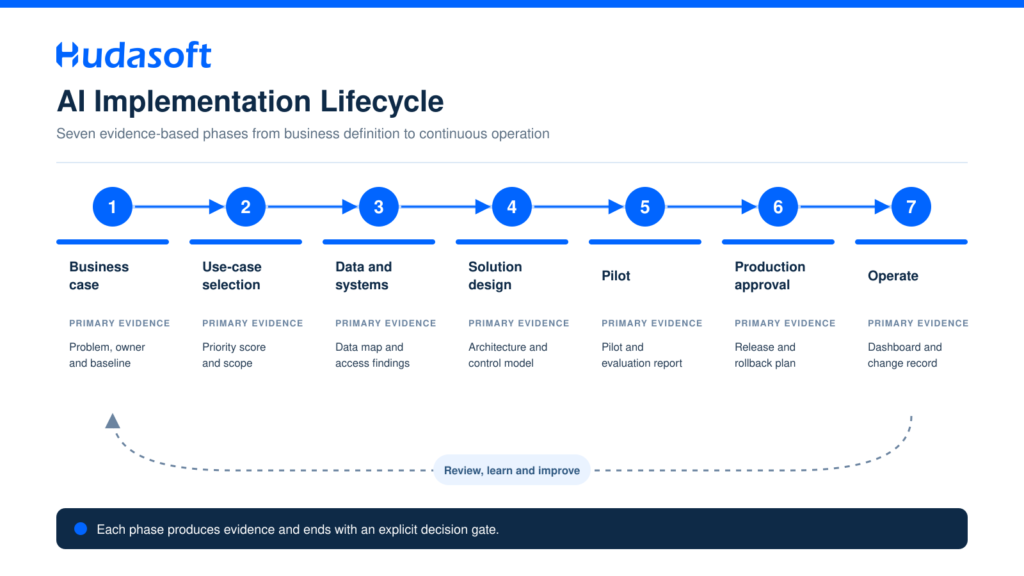
1. Define the business case
Describe the current workflow, its users, the decision or task that needs support, and the result the organization wants to improve. Record the baseline with operational evidence such as processing time, error rate, case volume, rework, service level, or cost per completed task.
Define the AI system’s role inside the workflow. It may retrieve information, classify an item, generate a draft, recommend an action, predict an outcome, or execute an approved step. This boundary keeps the project tied to a business responsibility.
Required output: an approved problem statement with an owner, target users, baseline, expected outcome, and initial risk classification.
Decision gate: Does the use case solve a specific problem with a measurable result?
2. Prioritize the use case
Score the use case across business value, technical feasibility, data readiness, integration effort, operating risk, adoption effort, and ongoing cost. A viable first project combines measurable value with a scope that permits controlled testing.
The selection record compares the candidate with simpler alternatives. Process redesign, analytics, rules-based automation, or an existing product may solve the problem with less uncertainty. AI fits tasks that require capabilities such as prediction, language understanding, content generation, perception, or adaptive decision support.
Required output: a prioritized use-case record with selection criteria, rejected alternatives, assumptions, and dependencies.
Decision gate: Does AI provide a suitable method for this problem, and can the organization support the required work?
3. Assess data and systems
Create an inventory of the data, applications, APIs, user roles, approvals, and downstream actions involved in the workflow. Test access instead of assuming that documented integrations work in practice.
The data assessment measures relevance, completeness, accuracy, timeliness, representativeness, and permitted use. The system assessment identifies authentication methods, rate limits, event triggers, record identifiers, error handling, and audit requirements.
Connecting models with ERP, CRM, document repositories, or internal applications requires interface design, access controls, validation, error handling, and monitoring. These activities form the delivery scope for AI integration services. The resulting AI integration strategy records how data moves, which systems can act on outputs, and where approvals and audit controls apply.
Required output: a data inventory, dependency map, access findings, quality report, and remediation backlog.
Decision gate: Can the team obtain, use, secure, and maintain the required data and system access?
4. Design the solution
Translate the workflow into system responsibilities. Define inputs, outputs, user interactions, model tasks, business rules, integration calls, human approvals, logs, failure paths, and support ownership.
The solution choice may involve a configured product, a model API, a RAG application, a custom model, an AI agent, or a hybrid design. Distinguishing agentic AI from generative AI clarifies whether the system only produces content or also plans steps, uses tools, and performs controlled actions.
Architecture follows the required responsibility. A recommendation tool needs different controls than an agent that updates customer or financial records. The design specifies what the system can read, generate, recommend, change, and send for approval.
Custom applications, model workflows, and production AI products place architecture, engineering, evaluation, and deployment within the scope of AI development services. The approved use case and acceptance criteria set the boundary for that work.
Required output: a solution design covering components, interfaces, permissions, controls, evaluation, deployment, and operating responsibilities.
Decision gate: Does the design meet the business requirement within the approved risk and investment boundaries?
5. Build and evaluate the pilot
The pilot tests the highest-risk assumptions with representative data and real workflow conditions. Its test set includes expected cases, edge cases, poor-quality inputs, prohibited requests, integration errors, and human escalation scenarios.
Evaluation uses a written test set, metric definitions, acceptable thresholds, and a record of limitations. Testing covers the complete system, including retrieval, prompts, application logic, APIs, permissions, user interface, and failure handling. Model quality alone cannot prove workflow readiness.
User testing involves people who perform or supervise the actual process. Their review measures whether the output supports a correct decision, fits the workflow, and communicates uncertainty or required action clearly.
Required output: a pilot, evaluation report, issue register, user feedback, and recommendation for production work.
Decision gate: Does the pilot meet the minimum business, technical, user, and risk thresholds?
6. Approve production deployment
A production review confirms system performance, security, privacy, integration reliability, operational support, user acceptance, and recovery procedures. It also identifies residual risks and records who accepts them.
The NIST AI RMF Core requires evaluation evidence that reflects the planned operating environment, together with documented system limits and continuing production review. These controls tie the release decision to observed performance and recorded risk.
Release planning defines the first user group, traffic or transaction limits, human oversight, feature flags, rollback method, support contacts, incident severity levels, and review schedule.
Required output: a production readiness record, accepted residual risks, release plan, rollback plan, and signed go or no-go decision.
Decision gate: Can the organization operate the system within its performance and risk limits?
7. Deploy, monitor, and improve
Start with a controlled release. Track system health, user behavior, business results, model or output quality, integration errors, security events, and operating cost. Compare outcomes with the original baseline and investigate gaps.
Monitoring links each threshold to a defined response. A threshold breach may trigger an alert, human review, traffic reduction, rollback, data remediation, prompt or rule changes, model retraining, or suspension of the capability.
Operational reviews compare actual use with intended use. Users may apply the system to new tasks, skip required review, or create manual workarounds. These signals can reveal training gaps, poor interface design, missing functionality, or unsafe expansion.
Required output: an operating dashboard, incident process, feedback log, change record, and scheduled performance review.
Decision gate: Does the system continue to deliver the intended result within approved limits?
Artificial Intelligence Implementation Plan
This implementation plan converts the framework into a controlled delivery record. It states who makes each decision, what evidence the team needs, what each phase produces, and what conditions permit work to continue.
Microsoft uses an adoption plan to convert AI direction into defined initiatives, resource needs, capability work, and delivery activities. NIST organizes lifecycle risk work through govern, map, measure, and manage. The plan below connects those source concepts with project ownership, deliverables, and approval gates; its structure and wording are original to this guide.
| Phase | Accountable owner | Evidence and deliverable | Approval gate |
| Business case | Business sponsor | Workflow map, baseline, target outcome, user group, risk tier | The problem and result have clear definitions |
| Use-case selection | Sponsor and product lead | Prioritization score, alternatives, scope, assumptions, dependencies | AI fits the task and the scope remains feasible |
| Readiness | Data, architecture, security, and operations leads | Data inventory, system map, access tests, gap backlog, operating needs | The team can close critical readiness gaps |
| Solution design | Solution architect and product owner | Architecture, control model, evaluation plan, delivery backlog | The design meets business and risk requirements |
| Pilot | Delivery lead and domain owner | Working pilot, test results, issue log, user findings | Results meet the agreed pilot thresholds |
| Production approval | Sponsor, security, risk, and operations owners | Readiness review, residual risks, release and rollback plans | Named owners accept production responsibility |
| Operation | Product and service owners | Dashboard, incident log, feedback, change history, periodic review | Results stay within approved business, reliability, and risk thresholds |
The project record contains the following items across all phases:
- Decision log: key choices, alternatives, evidence, approver, and date.
- Risk register: risk, cause, possible impact, owner, treatment, status, and review trigger.
- Dependency register: data, system, vendor, policy, staffing, and procurement dependencies.
- Evaluation specification: test cases, datasets, metrics, thresholds, reviewers, and known limitations.
- Change record: versions of prompts, models, data pipelines, application logic, integrations, and policies.
- Operating runbook: alerts, escalation, rollback, recovery, support, and maintenance procedures.
Budget planning covers discovery, data work, software engineering, model or API usage, infrastructure, integration, security, evaluation, training, change management, monitoring, and ongoing support. These are the primary AI development cost factors that change with scope, architecture, data condition, control requirements, and operating model.
The plan uses evidence-based gates instead of fixed calendar promises. Data access, vendor review, user testing, or system integration may change the sequence. A phase closes when the required evidence supports its decision.
Build, Buy, or Integrate
Delivery-path selection follows workflow and constraint definition. Product availability alone does not settle the choice.
Buy or configure
Choose a commercial product when it covers the required workflow, supports the necessary controls, connects with existing systems, and creates acceptable vendor dependence. Review data use, retention, model providers, access controls, export options, service levels, and change policies.
Build
Choose a custom build when the workflow, data, interface, decision logic, or control requirements create meaningful differentiation. A custom build also provides direct ownership of application behavior and supports combinations of multiple model and system components.
Integrate
Choose integration when an existing application needs AI capability without a full replacement. This path may connect a model or AI service with internal data, APIs, approvals, interfaces, and monitoring.
A hybrid path combines a purchased model service, a custom workflow application, and integrations with existing platforms. The decision record identifies which party owns each component, risk, update, and failure response.
Define Pilot Acceptance Criteria
A pilot establishes whether the proposed system can support a production decision. It uses measurable thresholds across the full workflow.
Business criteria
Measure the outcome tied to the original problem. Examples include processing time, successful completion rate, rework, error cost, case capacity, forecast error, or resolution quality. Compare the pilot result with the established baseline.
AI quality criteria
Select measures that fit the task. Classification may require precision, recall, and performance by relevant segment. Generative applications may require groundedness, completeness, instruction adherence, citation quality, and harmful-output testing. An agent may require task completion, correct tool selection, action accuracy, and escalation quality.
System criteria
Test latency, availability, capacity, API failures, authentication, authorization, data freshness, logging, and recovery. The test set includes degraded dependencies and invalid inputs.
Risk criteria
Test privacy, security, bias, prohibited use, unsafe actions, sensitive-data exposure, and human oversight. Record risks that the team cannot measure and explain how the operating model will control them.
User criteria
Measure whether users understand the output, know its limits, complete required reviews, and can report problems. Track workarounds and abandoned tasks because they may reveal workflow friction that technical metrics miss.
A production recommendation records which criteria passed, which failed, which remain uncertain, and which limitations users accept.
Plan Production Architecture and Integration
Production architecture surrounds the AI model with the controls and services needed for reliable use. A typical design includes:
- A user interface or system trigger that starts the task.
- An application layer that manages workflow state and business rules.
- A model, retrieval service, or agent that performs the defined AI task.
- Approved data sources with access and freshness controls.
- APIs that connect CRM, ERP, document, analytics, or operational systems.
- Identity, permissions, secrets, and policy enforcement.
- Evaluation, logging, tracing, monitoring, and alerting.
- A human review and escalation path.
- Version control and rollback for application, model, prompt, data, and configuration changes.
Agentic systems add planning, memory, tool access, orchestration, and verification to the control surface. A production agentic AI architecture therefore defines action boundaries, tool permissions, approval points, state management, and verification before an action reaches another system.
The integration design defines a contract for every connected system. That contract records the data exchanged, calling service, permissions, validation, expected response, timeout, retry policy, duplicate handling, failure owner, and audit requirement.
Apply Governance Throughout Delivery
Governance turns organizational policy into project decisions and system controls. The U.S. Government Accountability Office AI Accountability Framework organizes accountability around governance, data, performance, and monitoring. The same four areas map to ownership, data controls, acceptance criteria, and operating oversight in commercial projects.
Governance and accountability
Name the sponsor, product owner, technical owner, data owner, risk owner, operational owner, and approval authority. Define risk tolerance, required reviews, documentation, vendor oversight, and incident accountability.
Data controls
Record sources, ownership, permissions, quality, lineage, retention, access, representativeness, and update procedures. Apply controls to evaluation and production data as well as training or grounding data.
Performance controls
Define business, technical, user, and risk metrics. Establish thresholds, test conditions, reviewer independence where needed, and the evidence required for release.
Monitoring controls
Track performance and risk over time. Define alerts, escalation, reassessment, retraining, suspension, rollback, and retirement triggers.
Human oversight needs a specific operating design. State which decisions require review, what information the reviewer receives, how much time the reviewer has, and what action follows disagreement or uncertainty.
Measure Business and System Performance
One dashboard cannot explain every part of AI performance. A connected measurement model covers six operating dimensions.
Business outcomes
Track the metric named in the business case. Compare actual results with the baseline and account for changes in volume, staffing, seasonality, or process design that could affect the result.
AI behavior
Track task-specific quality, failure categories, performance by relevant segment, policy violations, uncertainty, and human overrides. Review representative samples even when automated metrics remain stable.
Application reliability
Track latency, availability, error rates, integration failures, queue depth, retries, and recovery time. AI quality provides little value when the surrounding application cannot complete the task.
Adoption and workflow fit
Track active use, successful task completion, abandonment, escalation, user feedback, and manual workarounds. Low adoption may indicate poor training, missing trust, workflow friction, or limited value.
Risk and control performance
Track access violations, sensitive-data events, unsafe outputs, unsupported actions, audit gaps, incident response, and overdue reviews.
Cost and capacity
Track model or API usage, infrastructure, human review, support, monitoring, and rework. Cost per successful business outcome provides more context than cost per model call.
The AWS Machine Learning Lens treats changing production data and model behavior as ongoing operating concerns. Google Cloud MLOps guidance connects production monitoring with automated validation and delivery workflows. Together, these controls extend measurement beyond the initial release.
Common Failure Points by Phase
Failures usually begin earlier than the stage where teams notice them. A weak problem definition appears later as an unclear ROI result. Missing data ownership appears later as unreliable output. An incomplete release plan appears later as slow incident response.
The table maps each failure to the phase where the team can prevent it.
| Phase | Failure point | Required control |
| Business case | The goal lacks a workflow, baseline, user, or owner | Approve a measurable problem statement and name the accountable sponsor |
| Use-case selection | The team selects novelty or executive interest instead of fit | Score value, feasibility, readiness, risk, adoption, and operating cost |
| Data and systems | Access, quality, permissions, or APIs remain assumptions | Test access, profile data, confirm rights, and record system contracts |
| Solution design | The team selects a model or vendor before defining responsibilities | Design the workflow, boundaries, controls, and failure paths first |
| Pilot | Testing uses ideal examples and model metrics only | Use representative cases and test the complete system under failure conditions |
| Production approval | The pilot moves to release without owners, limits, or rollback | Require a readiness review, accepted residual risks, runbook, and signed gate |
| Operation | Monitoring covers uptime without business value or behavior change | Monitor outcomes, quality, drift, adoption, risk, cost, and actual use |
Business case failure
The project begins with a technology request such as adding a chatbot or using generative AI. The team lacks a defined decision, task, user, and baseline. It can report that the system works, yet it cannot prove that the workflow improved.
The control is a problem statement that names the current process, evidence of the problem, system role, accountable owner, target user, baseline, and decision rule for continuation.
Use-case selection failure
The organization chooses a high-visibility use case with weak data or heavy integration needs. The pilot then spends most of its effort resolving prerequisites that the selection process missed.
The control is a comparative score and written assumptions. The review includes non-AI alternatives and a smaller scope that tests the main value claim under controlled conditions.
Data and systems failure
The project plan lists data sources and APIs without confirming access, ownership, quality, or permission. Engineers discover missing fields, unstable identifiers, rate limits, or security restrictions during development.
The control is a tested inventory. Readiness work retrieves representative records, validates joins, profiles quality, confirms permitted uses, and tests critical API operations.
Solution design failure
The model choice drives the architecture. The team then adds workflow, permissions, approvals, and monitoring late in delivery. This sequence creates avoidable rework and may leave unsafe capabilities in the application.
The control is responsibility-first design. Define what the system can read, infer, generate, recommend, and change. Then select the model and product components that meet those requirements.
Pilot failure
The pilot demonstrates success on selected examples and ignores edge cases, integration faults, misuse, and user behavior. It measures output quality without measuring whether the workflow reaches a correct completion.
The control is a written evaluation specification with representative cases, failure tests, thresholds, independent review where the risk requires it, and complete-system testing.
Production approval failure
The project treats pilot completion as release approval. No team owns monitoring, incidents, user support, model updates, or rollback. Residual risks remain implicit.
The control is a formal production gate. Approvers review evidence, accept named risks, confirm the runbook, set release limits, and retain the authority to delay or stop deployment.
Operating failure
The dashboard tracks uptime and request volume. It misses data drift, quality changes, user workarounds, new uses, policy violations, and weak business results.
The control is connected monitoring with response thresholds. AWS identifies deployment without drift monitoring as an operating anti-pattern, and Google Cloud explains why production quality monitoring must trigger new evaluation or retraining work.
Conclusion
Successful artificial intelligence implementation depends on a chain of evidence. The business case establishes the result. Readiness confirms that the organization can support the work. Design defines responsibilities and controls. The pilot tests the full workflow. Production approval assigns operating ownership. Monitoring shows whether the system stays within approved business, reliability, and risk thresholds.
One documented path connects these decisions. Named owners, deliverables, acceptance thresholds, risk treatments, and review triggers give business and technical teams the same operating record.
For organizations that need external delivery support, Hudasoft provides AI planning, development, integration, and production engineering around existing workflows and systems. The starting scope is one measurable use case with defined evidence for the next decision.
Frequently Asked Questions
What are the main stages of AI implementation?
The main stages are business-case definition, use-case selection, readiness assessment, solution design, pilot evaluation, production approval, and continuous operation. Each stage produces evidence and ends with a documented decision.
What should an AI implementation plan include?
The AI implementation plan includes scope, owners, inputs, dependencies, activities, deliverables, acceptance criteria, risks, approval gates, release controls, monitoring, and incident procedures. It also records major decisions and system changes.
How should a business select its first AI use case?
Compare candidate use cases across business value, feasibility, data readiness, integration effort, risk, adoption needs, and operating cost. Select a focused workflow with measurable value and manageable dependencies.
What is the difference between AI strategy and implementation?
AI strategy defines portfolio goals, priorities, investment boundaries, governance, and capability needs. Implementation applies that direction to one use case through design, delivery, testing, release, and operation.
How do you measure implementation success?
Measure the business outcome against its baseline and track AI quality, application reliability, adoption, risk, and total operating cost. The metric set reflects the actual workflow and the system’s level of responsibility.
When should an organization stop an AI project?
Stop or reduce the scope when the problem lacks measurable value, required data cannot support the task, critical integrations remain unavailable, risk exceeds tolerance, or the pilot fails agreed acceptance thresholds.

